
How to Build Creative Confidence When You Don’t Feel ‘Creative Enough’: A Published Author’s Journey
Introduction
Creative blocks are barriers that work to stop creative people from accessing their creative abilities properly. They’re often caused by things like fear, perfectionism or overwhelm. Creative Confidence is the way to tackle this.
Creativity Coach and Author Sara Thomson says:
“Creative blocks aren’t a lack of talent. Instead they’re usually about confidence, managing energy levels and sustainable practice.”
What You’ll Learn
In This Guide:
- ✓ The 5 most common types of creative blocks
- ✓ Techniques to overcome each type
- ✓ How to prevent blocks from recurring
- ✓ When to get professional creativity coaching support
- ✓ Free resources to get started
Before publishing my first book, I struggled with that age old question: “Just who do I think I am to tell this story?”
I had immersed myself in WWII women’s history for years, quietly researching without realising that it would all be useful for my book. I’d been a writer all my life, but not really for anyone else, except university lecturers and my mum. But, I’d always wanted write a book, so I began plotting a mystery and was shocked by how unprepared I was and, how difficult and complicated it actually was.
Still I persevered, and struggled on through draft after draft, adding and refining as I went. But, the big trouble came when I prepared to share my work. That little voice that whispers in your mind:
“You’re not good enough, you’re not a real writer, no one will want to read this.”
If you’re a creative of any kind, not necessarily a writer, but any kind of creative you’ve probably been crippled with creative self doubt and here you’re among friends who know just how that feels. Creative confidence isn’t something we’re born with, it’s something that often eludes us and we have to work on to keep building it brick by brick, through practice, understanding and proven techniques.
Today, I’m a published author and qualified creativity coach and but even with those books under my belt, it’s not been plain sailing and I often get bouts of self depreciation and confidence deserts me completely. I’ve recently come out of a five year block, which was the inspiration for me to train to be a creativity coach, so I could help others through similar blocks.
And through this journey I’ve found some strategies that can transform creative doubt into creative authority, so let’s get into it.
What Is Creative Confidence (And Why Do So Many of Us Struggle With It)?
Creative confidence is when you believe that you are able to generate ideas, express yourself authentically and create work that matters to you and others. It’s nothing to do with being the most talented, it’s about trusting your own creative voice enough to use it.
Research has said that many have trouble with creative self-doubt and there’s a few reasons for this:
- Perfectionism from years of societal conditioning to be everything and do everything
- Comparison-itis culture often made worse by social media and the constant bombardment of other’s seemingly perfect lives
- Imposter syndrome that tells us we’re not capable, not worthy, etc and we believe that little voice
- Fear of judgement keeps our work hidden because we’re so worried about Stephen from year 10 in school and what he and anyone else might say about us
When I began writing my first novel I had a Bachelor of Arts in English with Creative Writing and years of workshops and book reading knowledge, later I also had a Master’s degree in Creative Writing. On paper, I was more than qualified. But emotionally? I felt like a fraud.
That’s the gap between what we know intellectually and what we feel emotionally and this is where we need to bring creative confidence.
The Turning Point: When I Stopped Waiting to Feel Ready
I’ll never forget the first time everything changed. It was before I’d started writing that first book. At that point I’d told myself for years that one day I’d write a book. Then, I woke one morning fresh with that rare sudden clarity that this thing I’d been telling myself for years, that ‘one day’ I’d write it, would never come unless I actually made that one day today. It was a rare moment of absolute clear focus and I started to write that very first day.
That was only the first moment of creative confidence. Another came when I worked through the training to become a creativity coach and I realised all the ways I was holding myself back and all the ways I was allowing that little voice to control my creative life.
This is when I realised that creative confidence is not a prerequisite for creating your projects, it’s something that comes with time, it’s a result of doing the creative work.
I knew I needed to stop waiting for permission to be who I wanted to be, to work with the people I wanted to work with, to write what I wanted to write.
And, with that inner critic screaming at me, I started to be more consistent, to be more unapologetically myself, to be the person I was meant to be and bring my creative energy and business in the way I want it to.
My creative confidence was expanding the more I worked and the more I stepped into who I truly am.
5 Proven Techniques to Build Creative Confidence: Even When You Don’t Feel Creative Enough
These aren’t just theory. They are the techniques I used to move from crippling self-doubt to published author and creativity coach, and are also the same techniques I now help others to use.
1. Reframe Your Creative Identity
As an NLP practitioner, I know that the language we use shapes our reality. If you constantly tell yourself “I’m not creative enough,” or any other negative message, your brain believes it.
Try this:
I use a technique to help me realign that negative self talk to a more workable optimistic outlook, for instance:
- Replace “I’m not creative” with “I’m still developing my creative confidence.”
- Replace “I can’t do it” with “I’m still learning how to do this.”
- Replace “Who am I to write/create/paint/etc this?” with “I’m the perfect person to tell this story because…”
This isn’t about just mindlessly bringing toxic positivity. Instead, it’s neurological reprogramming.
Your brain can’t tell the difference between a belief that’s limiting and a belief that’s empowering. It’s up to us to consciously choose which we want to reinforce.
When I decided to rewrite my internal critic voice from aspiring writer, to author in training, everything changed for me. I gave myself the permission I needed to be imperfect while still moving forward. It allowed me to be where I was in that moment and not feel inadequate.
2. Collect Evidence of Your Creativity
Creative confidence often wobbles because we dismiss our own creative achievements, we believe that if it’s fun to create and be creative, it’s probably not any good and we don’t deserve to be paid for something fun.
But, if you think about it, you’ve solved problems, you’ve had original ideas, you’ve created something, whether that’s a meal, a solution at work, a story, a design, or a way to make people laugh.
Action step:
Create a Creative Confidence Brag File. Write down:
- All the times you’ve solved a problem creatively at work, home, or anywhere in life
- Any positive feedback you’ve received on your work over the years
- All the moments you felt proud of something you created, even if it’s just in private
- Any skills you’ve learned that need creative thinking and creative energy.
So, when those self-doubt gremlins creep in, you can look through this file and remember just what you have brought to the world.
3. Start Before You’re Ready (The Historical Fiction Lesson)
When I started writing my first novel, I didn’t know everything about WWII. I didn’t have every plot point mapped. I didn’t feel “ready.”
But I started anyway. And, I learned that creative confidence grows through doing, not through endless preparation.
You don’t need to:
- Read every book on your topic first
- Take another course
- Wait until you have more time
- Feel 100% certain
You need to take the first small step. Write the first paragraph. Sketch the first idea. Record the first voice note.
Action builds creative confidence. Waiting erodes it.
4. Separate Creation from Judgement
This technique transformed my writing process and is now central to how I coach creatives.
Your brain has two modes:
- Creator mode: Open, exploratory, playful, generative
- Critic mode: Analytical, evaluative, perfectionistic, judgmental
Most of us try to create and critique at the same time but this kills creative confidence faster than anything else I’ve seen.
The solution:
Create first. Judge later.
When I write a first draft, I give myself permission to write badly (very badly). I silence my inner critic and let the words flow as they need to. It’s only after this I I switch into editor mode and it’s this separation that gives me the freedom to create without fear, which is where true creative confidence lies.
5. Find Your Creative Proof Point
Nothing builds creative confidence faster than completing something and sharing it.
It doesn’t have to be perfect. It doesn’t have to be big. But it has to be finished.
For me, that proof point was publishing my first novel. Despite every fear, every doubt, every voice telling me it wasn’t good enough—I did it. And once I had that proof, my creative confidence improved massively. Because I knew: “I can do this. I’ve already done this.”
Your proof point might be:
- Publishing a blog post
- Sharing a piece of art
- Launching a small product
- Submitting your writing somewhere
- Teaching someone your creative skill
Choose something achievable, complete it, and let it be your evidence that you are, in fact, creative enough.
The Truth About Creative Confidence: It’s Not About Talent
Here’s what I wish someone had told me:
Creative confidence has nothing to do with being the most talented person in the room.
Yes I did say that.
In fact, it has everything to do with trusting yourself enough to show up, create imperfectly, and keep going. I’m not the most literary talented genius in the world. My historical fiction isn’t flawless. But I’ve built the creative confidence to share my work anyway, and that’s made all the difference.
You don’t need to be more creative. You need to trust the creativity you already have.
Your Next Step: The Creative Confidence Starter Kit
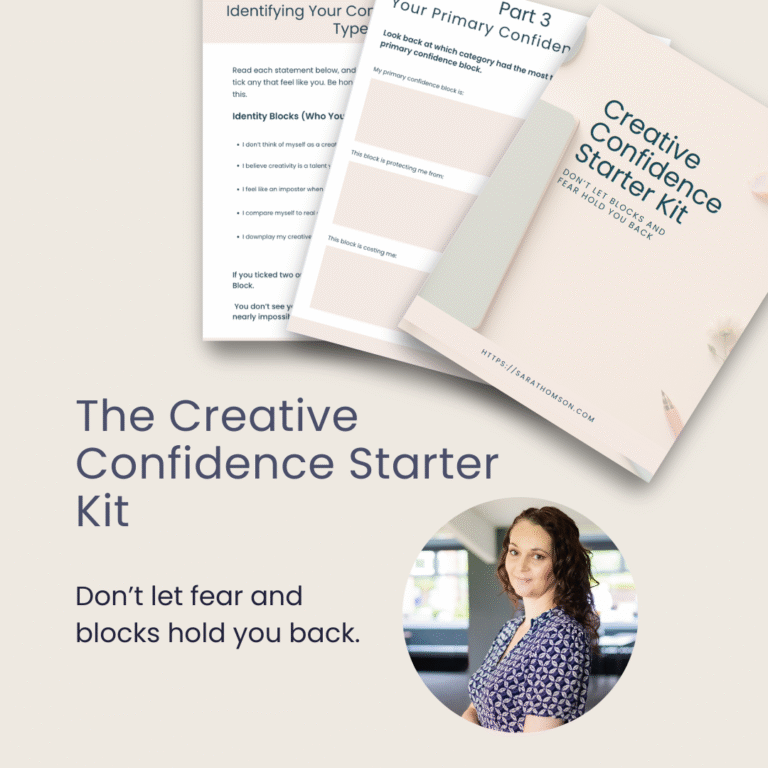
If you’re ready to stop doubting yourself and start creating with confidence, I’ve created something for you and the best thing is, it’s free.
The Creative Confidence Starter Kit includes:
- A worksheet to identify your confidence blocks (and how to overcome them)
- An NLP technique guide for reframing creative self-doubt
- A mini-action plan template to build your creative confidence step-by-step
It’s completely free, and it’s designed specifically for people who are tired of feeling “not creative enough.”
**Download your free Creative Confidence Starter Kit here**
Because you are creative enough. You always have been. You just need the confidence to believe it.
Key Takeaways
- • Creative blocks are normal and temporary
- • The Creative Unblocking Method addresses root causes, not symptoms
- • Sustainable creative practice helps prevent future blocks
- • Professional support accelerates breakthrough
- • Small daily actions build long-term confidence
By Sara Thomson
Advanced Creativity Coach | NLP Master Practitioner | Master Life Coach | MA Creative Writing (First Class) | BA (Hons) English with Creative Writing (2:1)
About the Author
Sara Thomson is a fiction author and coach specialising in overcoming blocks, building creative confidence and developing authentic creative marketing strategies. With 15 years marketing experience and a published author, she combines marketing and business expertise with deep creative understanding. Learn more about creativity coaching or download free resources.