Improving my Setting
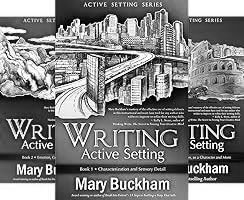
This week I wanted to talk about a book I recently finished. In fact, I love this book so much I’ve bought the series. It’s called Writing Active Setting by Mary Buckham.
One of my major problems with initial drafts is that I tend to leave out description and setting. This is because the events are happening so fast in my head as I’m writing, it’s important I get down the main bits before I forget.
However, the biggest issue with writing like this is that you then spend a lot of time going back over everything, adding in description.
As a reader, description is one of those things I don’t like too much of in books. I prefer to imagine the world my own way, sometimes completely differently from how the author describes it. In fact, I have been known to skip description scenes in some novels if they didn’t fit with the world I’ve imagined in my head (terrible, I know).
So maybe it’s a personal thing that I hate description, maybe it’s the way some authors write description, either way, it’s an issue for me. So I got this book by Mary Buckham in hopes of finding some inspiration or something to make me love description.
Buckham by far surpassed my expectations and did in fact show me ways to write a description that connected to action happening in scenes. So, what I mean specifically is ways to drip in description and give the story and setting depth without spending paragraphs writing about the dirty, abandoned building your murderer might be hiding in.
Not only this, but it showed me how to turn those boring description paragraphs I hate into exciting fun things that bring the story alive.
But by far the best thing I found was how Buckham describes how to use small sensory details to bring the reader deeper into the story and effectively bring it to life. Smell, they say, is under-used in fiction, so I tried to pay attention to this. Sometimes, describing something through its smell was easier than trying to give a long-winded description of it, for example, let’s say I was describing a really old coat, it might be clearer and easier to the reader if I described how that old coat smelt rather than simply saying it looked shabby.
This is a fantastic book with some great examples of ways to help you fix setting descriptions. I found the writer’s style simple and easy to follow; I will be re-reading this one.
If you write and struggle with descriptions, check out Mary Buckham’s book.