
Wartime Women in Britain: The Unsung Heroes of World War II
Much of the coverage, research and information around the Second World War focuses on the battles and the political and strategic elements of war, and although this aspect is absolutely important and something us, as modern readers, researchers and historians should absolutely learn about and treat with respect and understanding, my personal interest has always been with the the women left behind.
I suppose this comes from a combination of a fascination with the period and with being a military spouse myself for a lot of years. But, if we look closely at those women and their role in the wider story of that war, we get to see a tireless spirit and effort to keep things going at home, while the boys went off and did the important part of fighting a war. But, not only this their efforts played a vital role in shaping the course of history during this time, and arguably the following years too.
Today I want to talk about the research I’ve been doing into their lives and the breadth and depth of their contribution to the war effort, and what the impact of this was on society as a whole.

Recruitment and Mobilisation
As the clouds of war darken the skies over Britain, a call sounds across the nation; “Your country needs you.”
With the menfolk marching off to battlefields far from home, the need for people to replace them in jobs became a very urgent problem.
The government launched a nationwide recruitment campaign telling of the virtues of women contributing to the war effort. The result was a recruitment of women across the nation, who stepped up too fill the void left by their husbands, fathers, sons and brothers.
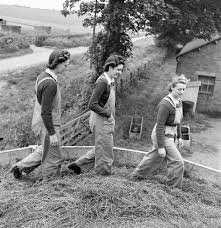
A whole host of recruitment posters were created to showcase the benefits of “doing your bit.” My current book focuses on the Women’s Land Army and I’ve been looking into a lot of the land army posters and recruitment campaigns, and my favourite is definitely the classic one with the strong, happy tanned looking girl with a pitchfork in the sunshine.
However, it wasn’t just the WLA there was also the Auxiliary Territorial Service ATS, the WRNs, the WAAF, WVS, etc. These government propaganda posters portrayed women as the backbone of the country, there to hold up the resilience, strength and determination of the country as a kind of way to channel the hope of everyone in times of great upheaval and uncertainty.

Types of Jobs
And it was then that women were able to do jobs that had so far in history only be reserved for men. From assembly lines making weaponry and ammunitions essential to the war effort, to (like my main character Eloise) ploughing fields and harvesting crops to feed the nation, women were discovering that they could do these ‘male’ roles and do them well.
But, even for those not wanting to work on the land or in factories, there was plenty of need for office and clerical work, alongside those specifically chosen to work in places like Bletchley Park and in the Home Office.
And, alongside this, there were the women who took up roles like driving ambulances, manning switchboards, volunteering and generally doing it all alongside other jobs or caring for their own families.
Despite the men doing a very important job, the women of the country also had some very important roles to fill, having to do many more jobs than in peacetime all while trying to keep their families going, worrying about their men, and often dealing with nightly bombing and wondering whether they have enough food to feed everyone.
Challenges and Discrimination
Yet, despite these numerous contributions, women had a lot of challenges to deal with in the workplace with unequal pay and very limited opportunities for career progression, alongside a very clear discrimination from many men who felt that women should not be doing these jobs – only serving to highlight the very clear and deep-rooted thoughts on gender roles.
Many struggled with the juxtaposition of these newfound roles as breadwinners, alongside the societal expectation of being a homemaker. And, these traditional societal expectations didn’t diminish in any way, women were, for the first time expected to do both.
Alongside this, the often physical demands of war work took a huge toll on women’s health and wellbeing, with long hours, exposure to hazardous chemicals and the constant threat of air raids, left a huge emotional and physical toll on them. But, despite this, they persevered and drove on to ‘help the boys’ and ultimately help the country survive and allow the men to win the war.
Daily Life
The daily life for wartime women was a balancing act between domestic demands and their duty to help with the war effort. They often worked from dawn until sunset and beyond in some cases.
After getting up early to see to family breakfast, they would then make their way to their jobs where they would spend long hours on assembly lines with very little in the way of breaks and sometimes not much in the way of food either.
Once the day ended they would then have things like housework and childcare to deal with, which would often mean spending many hours on their feet, cooking, washing and cleaning after long days at work. This was hampered by rationing and the lack of food abundance, making things difficult for them to make meals.
And, if you consider that there wouldn’t have been the convenience of things we have now like – easy quick meals we can shove in the oven, everything they made would have been done from scratch with very little ingredients, this makes cooking a much longer and more difficult process than we have now with our abundance of food supply and our easy quick food and cooking options if we’re in a hurry.
Alongside this, just cleaning and washing clothes would have been a difficulty without the convenience of modern washing machines, tumble dryers, electric hoovers and modern cleaning products. Everything was much harder, took longer and was just a bigger job than it is now.
However, through all this, many women supported each other and shared tips and ideas on quick meals, cleaning suggestions and other ways to help make life a bit more bearable.
Social Change and Empowerment
These war years shifted the status of women in a very profound way that would go on to have an impact in shaping the modern world we now live in.
Freed from the constraints of what a woman should be and the role society set out for her as compulsory, these women embraced this newfound independence and took on the challenge of roles that were ‘men’s’ with enthusiasm. And it is the success they made of this that further embedded the seeds of women’s rights and social change. This would advance the women’s rights movement much faster than it would have done without it.
Legacy and Impact
The legacy of these women vibrates through the decades to shape the women we are today and their contributions, despite often being overlooked, were absolutely vital in the strive for victory in the face of such danger and upheaval for everyone.
The women of this period are definitely the unsung heroes of our past and are a testament to all the things we now have.
Their lives stand as a testament to the power of perseverance and the unquestioning spirit of determination. Their legacy is one of courage, sacrifice and resilience, but they always often said they just got on with it.
And this is definitely something I can associate with. When my husband was going away, sometimes to dangerous places, you find yourself having to just get through each day and each day becomes a little win. But, not forgetting I was doing all this without having to worry about being bombed, not having food, having to do wartime work on top of everything else. Compared to these women what I had to do was very easy, however it was one of the hardest periods of my life, so if you add on all the other things these women had to deal with, it really is astounding how well they did, how they not only coped but excelled at it.
We really do owe them a lot on so many levels when their brave attitude of ‘just getting on with it’ got us through one of the darkest period’s of our history.